
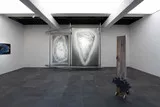
Gallery Where is pleased to present the group exhibition "The Eternal Return of A Gaze," opening on November 2, 2025, featuring recent works by four artists: Gao Wenqian, Li Hanwei, Li Qinyang, and Wang Chao. "The Eternal Return of A Gaze" suggests a state of viewing that is non-conclusive, processual, and suspended. This state possesses the potential to penetrate the order of physical and psychological, real and virtual spaces, inviting viewers into a still-emerging field brimming with undercurrents of uncertainty.
In Li Qinyang's practice, the state of "lingering" often refers to a moment suspended in an unknown direction — a tranquil yet portentous scene, an interior space leading from the physical interface into the depths of memory. As the perspective shifts, the balance between emotion and power appears constantly challenged and reconfigured, until the underlying unease is evoked.
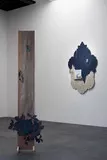
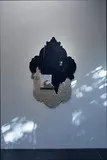
In the work Home Sweet Home III, Li Qinyang employs the form of a "door" as both a structural and symbolic focal point, alluding to the liminal state between "entering" and "leaving." This duality hints at the interplay between opening and closure, memory and oblivion. The surface of the door is covered with textures composed of fragmented family images — these visuals carry intimate and tender private memories, yet are eroded by ants crawling across them. Here, the presence of ants transforms into a metaphor for temporality, symbolizing the erosion and dissolution of memory on both biological and material levels, thereby revealing the contradictory relationship between warmth and decay, preservation and loss.
As a starting point for spatial narrative, this door not only signifies a physical interface but is also imbued with psychological and symbolic dimensions. It becomes a liminal device leading into the interior of memory, guiding viewers—through the act of crossing and gazing — into an inner space composed of private narratives, emotional remnants, and temporality. Thus, the existence of the door transcends its architectural function, becoming a psychological metaphor for memory, trauma, and representation.
Wang Chao's works possess an ethereal and expansive quality. Upon prolonged gazing, one seems to perceive shifting glimmers of light and drifting mist.
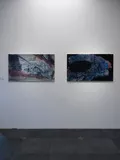
The hazy atmosphere and illusory, distant artistic conception in the imagery stem, on one hand, from Wang Chao’s pure pictorial elements composed solely of water and ink. This approach echoes the pomo (ink-breaking, 破墨) technique of the Tang and Song dynasties, which exploits the mutual permeation and diffusion of ink with ink, and ink with water in their wet states to enrich layers and texture. On the other hand, it arises from the artist’s abandonment of predetermined themes, narratives, or concepts in his creative process. Precisely because the forms are not confined to representing particular objects, they encompass boundless possibilities. Most importantly, the composition lacks a unified viewpoint or light source, allowing the artist to freely reconstruct an internal spatial order, resulting in a holistic and seamlessly resonant vitality throughout the painting.
Two pieces of new works in the exhibition both take "Sumeru" as their imagery, merging the external cosmic landscape with the artist’s internal psychological map. This fusion also guides the viewer’s gaze from the outer to the inner, evoking a sensation of wandering through "fog".
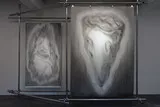
Starting from a vague poetic metaphor and progressing through collaborative labor and repeated gaming with data, algorithms, and machines, the work ultimately culminates in what Li Hanwei describes as a "visual haze" suspended at the ambiguous edge, formed by the superimposition of a series of "procedural traces." This suspended, indistinct visual state stems first from Li Hanwei's contemplation of painting in relation to artificial intelligence—for AI, the true challenge lies not in the subject matter or method of creation, but in the initial motivation behind the act of painting itself. Thus, Li Hanwei provides ambiguous instructions filled with uncertainty, which are difficult for AI to effectively comprehend, while disregarding the outcomes of its creations. Instead, he shifts the focus of the creative process to the very act of image generation.
In the practical production process, he transfers newly generated, replicated, and reorganized images from the database, along with 3D textures produced by over ten flagship 3D printers from the renowned Chinese company Bambu Lab, onto transparent acrylic panels. These are then fixed using fully transparent gel medium from the American paint manufacturer Golden, combined with oil-based materials. Through transfer, layering, disruption, and restoration, this "cycle" is repeated over 300 times. Simultaneously, during the manual phase of each work, he intentionally leaves behind the biological trace of the creator — an enlarged fingerprint — allowing this manual "flaw" to coexist with the "perfect" computational traces.
The perpetual tension between AI's "logic of efficiency" and the "flaws" of manual intervention, the "precision" of machines and the "accidents" of material transfer, ensures that Li Hanwei's painted images remain eternally in a "lingering" state of becoming. The uncertainty and ambiguity manifested in the images also align with his impression of the face of our era: shaped by technology, pulled by politics, and difficult to grasp at a single glance.
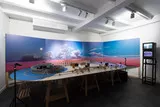
Time often serves as a thread in Gao Wenqian's works, pointing to the intersection of the virtual and present reality — such as the disturbance of reality by virtual worlds, or the ways in which motivations within virtual worlds stem from certain "occurrences" in the real world. The newly iterated work The Potemkin Village functions like a precisely calibrated "automatic movie machine," a real-time interactive video installation through which Gao Wenqian explores time, illusion, and the generation of reality.
The inspiration for The Potemkin Village draws from the famous historical anecdote of Grigory Potemkin, a Russian Empire general, who constructed fake, prosperous villages to impress Empress Catherine II. Gao Wenqian appropriates this historical narrative, casting the viewer in the role of the "Empress." Standing in front of the work, they observe these nearly infinitely changing landscapes: as a train passes by, sensors switch cameras to track it, while AI generates continuously flowing animations in real time from the cameras feed. The train, running on a looped track, ceaselessly activates endless scenery. Meanwhile, viewers are free to assemble cards with images on the sandbox, much like building blocks, prompting the AI to generate what might be called "video bonsai."
In the work, the train is endowed with a controlled, cyclical "image of time." Yet, within the AI generation process, this image is perpetually disintegrated and reshaped, breaking free from the constraints of the original model. It reflects a fundamental tension: while we constantly strive to capture and define reality, true vitality emerges precisely at the moment when models fail and meaning escapes.
Text by Han Xindi



GAO WENQIAN(高文谦)
Gao Wenqian (b. 1988) obtained his bachelor's degree from the Printmaking Department of the China Academy of Art and his master's degree from the École des Beaux-Arts in Paris. He currently lives and works in Beijing. His practice spans interactive installation, gaming, experimental video, internet art, and sound, revolving around the "meta-narrative" of media itself. By constructing "model" scenarios as thought experiments, he explores the contradictions and paradoxes of the world. In recent years, his work has focused on drawing inspiration from nature to simulate different life-technology systems. Gao Wenqian has received awards including the 2022 FutureTense Award for Digital Art, the K11 Emerging Art Creation Award with Special Jury Recognition, the SAP Art Award for Emerging Artist of the Year, Best Animation at the 7th Vancouver Chinese Film Festival, Best Short Film at the Berlin Short Film Festival, Best Animated Short at the Jaipur International Film Festival, and the Lin Fengmian Creation Award Silver Prize.

LI HANWEI(李汉威)
Li Hanwei (b. 1994) graduated from Shanghai Institute of Visual Arts with a major in Photography and currently lives and works in Shanghai. His practice spans video, installation, painting, and curation. Li Hanwei's work focuses on the fluid emotions and structures within the Chinese internet environment—from nationalist fervor and algorithmic euphoria to the alienation and control of digital labor. Employing advertising narratives, aesthetic packaging, and platform culture, he transforms these charged social mechanisms into concrete visual and spatial experiences. Recently, he has utilized artificial intelligence and 3D printing technologies to advance his painting experiments, converting concepts of efficiency, circulation, and dissolution into material traces within images, thereby mapping the collective psychology of digital society. Li Hanwei has received the inaugural K11 Curator Award, the Porsche "Chinese Young Artist" Award, and was a finalist for the Dior New Talent Photography and Visual Arts Award.

LI QINYANG(李沁洋)
Li Qinyang (b. 1998) obtained her bachelor's degree from the Printmaking Department of the School of Fine Arts at the Central Academy of Fine Arts and her master's degree in Printmaking from the Royal College of Art in the UK. She currently lives and works in Shanghai, China. Li Qinyang focuses on the elusive gap between the essential meaning of images and everyday objects and the emotions they evoke. Utilizing patterns, image archives, and ready-made objects, she transforms and reconfigures them between 2D images and 3D installations. Through her practice, she gently responds to the nonlinear influence of memory, explores the contradictions and complexities of distance and intimacy, and connects the hidden power dynamics within private spheres to broader social structures and environments.

WANG CHAO(王超)
Wang Chao (b. 1986) holds a master's degree from the Xi'an Academy of Fine Arts and currently lives and works in Xi'an, Shaanxi Province. Wang Chao is fascinated by the seemingly harmonious yet constantly contested relationship between ink and water. They deconstruct each other and perpetually recede — much like ink settling on paper while water evaporates into the air. Water can never fully dissolve the ink, nor can ink completely capture water; the resulting artwork is merely a trace left by their interplay. His painting practice is also a process of abandoning themes and concepts while continually dissolving the characteristics of the brushstroke. The construction of the image stems solely from the most fundamental elements of Chinese painting—"water" and "ink", and the infinite variations that arise from them.