POLLINATORS AND PRIMORDIAL SOUP

Chen Menghan
Ge Tairan & Tenzin Dhame
Hugo Teixeira
Shang Ying
Wu Yumo

Curatorial concept by Zhao Mengsha
15 June - 27 July 2025
Gallery Where, Beijing
DOWNLOAD PRESS RELEASE

"Poets and scientists alike point to the interconnectedness of things... Analogies are real, metaphors manifest at the chemical level."


—— Anatomy of a Rose by Sharman Apt Russell


The gardener's seasons unfold eternally within her garden. She marks time by phenology, then with soil-stained hands paints each flower she's cultivated. This laboratory of hers—the garden—represents humanity's smallest parcel of nature, albeit an isolated, curated nature. Selected for utility, beauty, or fragrance, only those aspects deemed valuable to humans survive horticulture's sieve. Yet once enfolded by plants' solace, even when nature commands with caprice, one submits willingly to the cyclical labor of weather, blight, and the rise and fall of growth.


Kneeling to bind wayward climbing roses, the gardener fails to notice three worker bees debating her futility through waggle dances beneath her straw hat's shadow—a dissonant narrative between symbiotic species: is this a "nectar source" or a "human's potted landscape"? Leafcutter bees, leafminers, thrips, and stag beetles go about their business, indifferent to human vexations. Sunlight refracting through petals makes an evening primrose flash distinct lures: beauty to the gardener, sweetness to insects. The ultraviolet hues perceived by compound eyes remain unimaginable; the canvas captures but one interpretation.

Humans project emotions into floriography, burdening blooms with vernacular names—"Night-Blooming Jasmine" and "Forget-Me-Nots" often belong to different genera. Science, in its hubris, insists on signing nature with binomial nomenclature, cleaving a taxonomic path to clarity. Artists demur: nature's halo manifests through fruit and foliage, and should they wish, entire forests could be dyed Prussian blue with synthetic pigments.

Poets and botanists first decoded divinity in leaves, recognizing these organs as embodiments of primordial fluidity. A plant transforms cotyledons into fruit, seeds into new life—like Proteus the shape-shifting sea god, becoming the perfect metaphor for phenotypic plasticity and evolutionary adaptation. Plucking ginkgo leaves from a 270-million-year lineage creates living bookmarks in natural history, their pages recounting survivals from ice ages and continental drifts. After all, ginkgos' story began long before human civilization.


Thus in nature's study, art reveals itself as the nexus of vision, emotion, and lived experience—an exploration of being itself. When painter and viewer commune with a flower, or dissolve into stone's microstructure, they grasp why lotus and mineral both embody water: one birthed by water, the other its crystalline tomb. Mineral pigments ground in water emerge along silk's warp and weft, lotus veins and crystal lattices sharing symbiotic architectures. Concentric rings in cross-sections mirror Earth's chronology; every brushstroke becomes a palimpsest of geological time.

To learn from "nature" (自然) is to apprehend "self-so-ness" (自然). All beings—including "I"—exist within a greater ecosystem. Ancient philosophies envisioned the cosmos through air, fire, earth, and water; Tibetan medicine sees these same elements constituting human viscera. Organic matter forms life's substrate. Darwin speculated that all organisms might have emerged from a "warm little pond" of inorganic soup—given the right conditions, chemistry begets biology, molecules coalesce into cells, and life blossoms into today's profusion.

Myths are the collective unconscious dreaming. Global mythologies share archetypes like a self-referential code, adapting to cultural frameworks. Their recurring motifs reveal how humans interpret existence. Tibetans who worship water spirits abstain from fish; urban legends evolve into folk beliefs. Mermaids or earth goddesses weave aquatic-terrestrial ethnographies. The Nyangmi legends from the plateau may offer ancient wisdom of "reverential symbiosis" for our age of ecological crisis.

Another human obsession: migrants eternally seek familiar landscapes. Why did Swedish settlers trek to Minnesota? Why did Portuguese descendants recognize Iberian scrub along Pacific coasts? Homesteads root in kindred vistas; familiar agroforestry brings comfort. New worlds become palimpsests of homelands—renamed wildernesses, immigrant experiences distilled into georgic poetry, memories preserved through oral lore. Stones, plants, migratory birds, and weather whisper this truth: nature's coincidences and resemblances persist because we all sprang from the same primordial broth.


Text by Zhao Mengsha


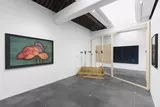
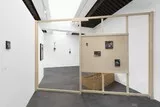
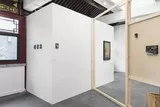
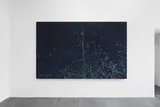
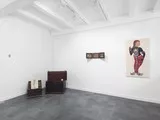
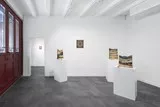
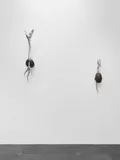
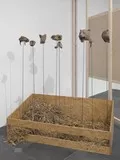
INSTALLATION VIEWS
ABOUT THE ARTIST

CHEN MENGHAN(陈孟涵)


Chen Menghan (b. 1998) Graduated with a BA in Art History from New York University and an MA in Fine Art from Chelsea College of Arts, University of the Arts London. Currently lives and works between Beijing and London. Chen’s practice explores the growth and metamorphosis of life. Her sculptures sample from the plant and animal world, blending them into surreal organisms that capture the transmutation of vital energy. Through reimagining nature, she employs allegory to articulate the intelligence inherent in natural processes, mirroring the inner landscapes of humanity.


CHEN DUXI(陈督兮)


Chen Duxi (b. 1983) graduated from the Fine Arts College of Sichuan Conservatory of Music, currently based in Beijing. Chen maintains an observer’s perspective when engaging with social life. To sustain his acute sensitivity, he frequently immerses himself in nature through hiking and cycling, examining plants, stones, and insects with a near-microscopic gaze. His exploration of painting’s primal language involves studying the evolutionary logic of Chinese painting across dynasties, cross-referencing its uniqueness through diverse civilizational lenses. Tracing the river of human cultural development—from ancient artifacts, carvings, and pictographs to prehistoric fossil specimens—he finds that the more archaic an object, the more unadorned and closer to truth it becomes, offering transcendent spiritual resonance. Thus, Chen’s work emphasizes linear expression, seeking to unveil the mystical forces behind painterly impulses, convinced that image-making can reveal infinite paths beyond cognitive limits. Series like Contemplate and The Order of Body merge geological precision with literati brushwork, embodying the Daoist principle of “mutual generation of vital energies”.


Show more →


GE TAIRAN & TENZIN DHAME(葛泰然与旦增达美)


Ge Tairan (b. 2000) and Tenzin Dhame (b. 1997) were born in Anhui and Lhasa respectively, both graduated from the Central Academy of Fine Arts (BA/MA) and now work in Beijing. As a collaborative duo, they are known for interdisciplinary and experimental practices that blend research with fiction to interrogate contemporary mythology and interethnic narratives. Their shared interest in cross-cultural and multispecies storytelling led to a 2024 nomination for the "E.A.T. Prize Annual Artist Award."


Show more →


Hugo Teixeira


Hugo Teixeira (b. 1981) was born in Lisbon and raised in San Jose’s Luso-American community, this linguist-turned-artist studied photography at San Jose State University and Lisbon’s School of Image and Communication Technologies, where he developed an interest in alternative photographic processes. After earning an MFA from Rochester Institute of Technology (2020), he settled in Macao (2010), becoming one of Asia’s few practitioners of handmade photography. His conceptual works—spanning images, sculptures, and mundane materials—interrogate memory and technology.

SHANG YING (尚盈)


Shang Ying (b. 1980), Beijing-born, a devoted plant enthusiast and stamp designer who occasionally paints.


WU YUMO (吴禹墨)


Wu Yumo (b. 1988) was born in Nanchang and graduated from China Academy of Art, Wu currently lives and works in Beijing. Her practice emerges from site-specific dialogues with nature, focusing on everyday ecological connections. In mountains, streams, or transient travel spaces, she lets paper and fabric absorb mist, leaves, and river water, minimizing intervention to allow organic, meditative creation. Series like Whispers of Nature and Natural Records employ cyanotype to amplify nature’s agency: after placing sensitized sheets in environments, outcomes are wholly surrendered to elemental forces—light, water, wind, and temperature unpredictably shape the images. Wu consciously positions herself in symbiotic equality with her surroundings, dissolving boundaries between subject/object, human/nature, and form/expression.