
Since the 10th century, Chinese landscape painting has introduced multiple viewpoints into the flat space, creating a dynamic viewing mechanism through the transformation of space in the dimension of time, multidimensionality, overlapping, parallelism, and interlacing, making painting the ultimate balance of time and space. However, with the development of perspective, the scientific depiction of space led to the gradual singularity of temporal order within the picture and its detachment from space. It wasn't until the rise of philosophical trends like rationalism in the 18th century that "spacetime" shifted from objective narrative back to a subjective cognitive structure, returning to the dynamic viewing mechanism. The development of image and installation art further systematically changed the existing objectified viewing consciousness.
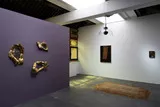
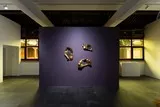
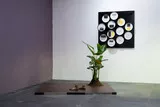
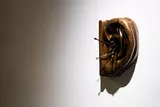
"The clock is a timing tool, a materialization of time, a symbol of order and rules, and even... an embodiment of absolute power." The ticking of the clock serves as evidence of the passing of time, with our ears constantly listening and being disciplined by its rhythm. In the sculpture "Lost Needle," clock hands are inserted into the ears of the main subject, undoubtedly portraying a confrontation with time, an act of "de-temporalization." In the game of chess, the "pawn," derived from the word "foot," symbolizes movement, historically referring to infantry and later to soldiers; "pawn" also carries the meanings of ending and stopping. In Zhao Yu's work "Advancing World," French phrases such as "'His culture' is true desire" and "To create good hybrid works, first the artist must become a true 'genetic hybrid person'" are inscribed on the feet of the figure, emphasizing the idea of hybridity and confrontation implied in traditional chess formations, pointing towards relationships of confrontation, play, and coexistence. Zhao Yu reinterprets the traditional phrase "Chu Han Boundary" as "World," merging two chessboards together, with a faintly visible image of a banana tree at the base, portraying an ambiguous, hard-to-trace origin and stance. The vegetation paradise bird juxtaposed with the banana tree represents a domestic and scenic presence. The title of the work, "A Room of One's Own," is inspired by Virginia Woolf. Zhao Yu contemplates and reconstructs "a room of one's own" through the lens of female privilege and the writer's perspective. The artist takes different "rooms" she has lived in as the exhibition space, exploring the absolute privacy of the writer's creative state. Writing is akin to the Tower of Babel, forever unattainable at the top, mirroring time's endlessness, which we all endure. The artist delves into the constraints of writing in private spaces, the materialization of time, and one's stance against power. By removing the hour and minute hands from the clock, she disrupts the clock's essence of "time," questioning the homogenization of global time and challenging power structures.
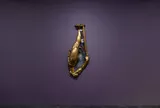
First prepare the framework, then fill it with content. This workflow shares many similarities with today's creative/manufacturing industries. This process implies setting limitations on the creative force before fully unleashing it. Li Weiyi adheres to this practice in her series "Sooner or Later": framing first, then filling with content, is a literal obedience. She creates frames using parts cut from famous classical sculptures — spaces enclosed by bodies. These are typically underarms, between legs, or gaps between bodies when two people embrace. Subsequently, based on the spaces enclosed by such frames, she starts creating content — the artist has made many "bubbles." The images of these bubbles do not originate from the real world; they are digital creations simulated by software. Whether it's "Illusionary Bubble" or "homo bulla," bubbles symbolize the fragility and transience of life in different cultural and religious contexts. It's like the game we used to play in the bathroom as children: forming a ring with our fingers and watching a thin film of soap take shape between them. This is the most straightforward demonstration of the relationship between framework and content. The interaction between the human body and bubbles represents a give-and-take dynamic, a constant flux between presence and absence.
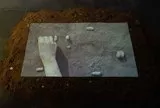
The original riverbank mudflats in the Qing Shan section of Wuhan are gradually shrinking. Apart from the neat routes planned in urban surveys, only a primitive pathway remains for one or two people to stroll along. In the artwork "In the lane, It draws," Han Qian explores along this remaining mudflat shore and collects various sediments transported here by nature. These materials from different times and spaces, constantly eroded by the river water, gradually form circular or elliptical surfaces. They carry memories of the upstream and river water, composing the former path of this mudflat, most of which has now disappeared. In the artwork, the artist uses collected pebbles to piece together the interior space of an old house from her memories, while the voiceover in the video is based on the oral map description of the same old house space by the artist's grandfather. In the intersection of geological time and personal time, in the movement of hands and the stagnation of speech, lies the traces of wandering memories and paths.
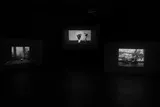
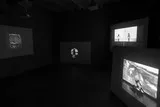
Chai Mi believes that time and space can be inseparable, much like Einstein's concept of "Spacetime." Our fascination, use, observation, and study of other living beings have persisted throughout human history. The ways in which we interact with other organisms and our own kind have always appeared in a form of temporal-spatial confusion. The connections are complex and enduring. The series of works "Spacetime Illusion" focuses on the deliberate use of long shots and scene scheduling, intentionally prompting the audience to make continuous viewing choices.
Chai Mi, Han Qian, Li Weiyi, and Pocono Zhao Yu use techniques such as image recombination, long shots and scene scheduling, the relationship between the physical and the virtual, and the relationship between text and physical installations to create a synchronicity experience in space, opening a flow of spacetime beyond the realm of reality for viewers.



Chai Mi (b. 1985) graduated from the Academy of Arts & Design, Tsinghua University. In 2018, she was awarded the fellowship of Visual Arts by the Civitella Ranieri Foundation in New York. She currently works and lives in Beijing. Chai Mi's artistic practice revolves around individual identity, personal experiences, and nomadic thoughts, using various media to explore visible clues and hidden relationships in everyday life, revealing their ambiguity and fluidity. She pays attention to the struggles of individuals or groups across different time and space. Her artistic creation integrates various media such as moving images, photography, painting, installation, text, performance, and curation. Her work consistently reveals explorations into the ways objects, living organisms, and consciousness are related, as well as reflections on entrenched concepts and established rules...

Han Qian (b. 1993) obtained a Bachelor's degree in Art Printmaking from the Academy of Fine Arts in Rome, Italy in 2016, and a dual Master's degree in Fine Arts from the National School of Fine Arts in Paris, France in 2021. Han Qian's creative pracice combines various media such as video, installation, performance, printmaking, and writing and focuses on the subtle perceptions and identity memories hidden in the reorganization of multiple space-time and historical threads. She attempts to present her works as a constant journey between the past and the present, with the search for unspoken memories and diaspora identity always pulling her writing. In recent years, her work has revolved around the threads of personal family and industrial migration, focusing on the migration and settlement of generations, and the specific historical and material changes that accompany them, as well as re-imagining and re-perceiving the changing landscapes, identity politics, and geo-identities within them...

LI WEIYI(李维伊)
Li Weiyi (b. 1987) completed a series of projects and research related to design at the School of Architecture at Tongji University (BA), the School of Art at Yale University (MFA), and the Royal College of Art (Ph.D). Many of her works stem from reflections on decades of experience as a designer and image creator, contemplating the various cruelties within the image-making industry, the efficiency and delays in communication through images, and a fundamental question: In a world increasingly dominated by similar digital image and construction tools, how can we, as creators, continue to create? Through the process of creating and receiving feedback from audiences, she repeatedly reaffirms that art might be the only existing opportunity to connect all of us as humans. It is a place where the power of acknowledging "unacknowledged things" or even "misunderstood things" is recognized in the world, where at this moment, "misunderstanding" rather than "complete understanding" may bring people from different cultural backgrounds together to create something new.

Pocono Zhao Yu (b. 1991), currently lives and works in Shanghai and Paris. She graduated with a DNAP degree and a DNSAP degree from the National School of Fine Arts, Paris, France. Her work is primarily focused on transforming the perspective of "self-culture" into the "other-culture" viewpoint, juxtaposed within a deep spatiotemporal framework for reflection. She translates this through various mediums such as images, videos, writing, and installations. Drawing from personal encounters, she reconstructs scenes by borrowing elements from semiotics, literature, and related sociological disciplines, aiming to present the flow of civilizations and cultural transformations worldwide. A "new" narrator emerges, embodying the image of an "intruder" to question the truth of history, exploring and responding to the intricate connections between originals and copies...